 |
|||

|  |

|
|
Guest Columns
Perspective:
Dairy Markets
New equilibrium for whey protein prices
Mike McCully
Mike McCully is owner of McCully Consulting, South Bend, Indiana, and contributes this column for Cheese Market News®.
 |
| Graphic provided by McCully Consulting |
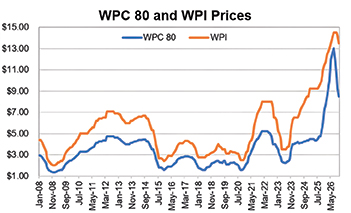
Prices for whey products have set record highs in the last year given unprecedented demand for all things protein. However, in recent months, prices for whey protein concentrate 80% (WPC 80) and whey protein isolate (WPI) have been moving lower but at different speeds. WPC 80 has fallen around 40% from summer highs while WPI is only down 10%-15% from its peak. The fear from manufacturers is whether whey protein prices will go through their historical cycle of boom and bust. And right now, everyone is asking what level will prices settle at?
Over the last 20 years, WPC 80 prices ranged between around $1.50 per pound on the low side and $5 per pound on the upper end. However, this spring’s rally took prices to $13 per pound before falling back toward $8 in the last month. The market is in flux with buyers coming back to top up Q4 needs and book Q1 and first-half 2027 supplies. However, September production was up 6.9% versus one year ago, while stocks finished the month up 35% versus last year, which pushed the months of supply to a 20-month high. A wide gap between WPC 80 and WPI prices is expected to result in some volume shifting to WPI production, which will lessen the supply of WPC 80.
In contrast, WPI supplies remain relatively tighter despite Sept. 30 stocks being up 43% versus last year. U.S. WPI prices have fallen into the $13s, with scattered reports of some sales above and below that range. In Europe, reported prices are in the mid-€20s per kilogram. More downward pressure is expected in WPI as some WPC 80 production shifts to WPI, while WPC 80 could stabilize given high milk protein concentrate 85% (MPC 85) prices.
Unlike WPC 80, WPI demand has been more inelastic given specific use cases in sports nutrition products and other food and beverage products. Food brands have been reluctant to reformulate given consumers’ interest in whey protein and the functionality WPI has in sports bars, beverages and supplements. Clear protein has also been in strong demand given its use in ready-to-drink beverages, although supplies have been building.
The strong demand for whey protein has also impacted the carbohydrate side of the whey complex. CME sweet whey prices are making new all-time highs this week over $0.90 per pound, although other indices are in the mid-$0.70s, near the top end of their historical range. Prices in Europe have been premium to U.S. prices, which has resulted in record-high exports in recent months. Lactose has also been in strong demand with prices at the highest point since 2013. The rally in prices for both of these products is likely nearing an end, although downside is limited.
The outlook for protein demand tied to GLP-1 use is positive, though the effect is smaller than the headlines suggest. GLP-1 users shrink total food intake but shift what remains toward protein, and they influence household purchases beyond the users themselves. GLP-1 users eat smaller portions, prioritize protein, and cut back on snacks and alcohol. Protein matters to them for satiety, metabolic health and muscle preservation.
GLP-1 users consume lower volumes of food but place higher value on protein-rich products. More consumers are expected to use the pill form versus an injection because of its ease, which could mean long-term changes in demand. Cheaper or oral options would broaden the user base, although high discontinuation rates would cap it. While the U.S. has the highest adoption rate, strong growth is expected in other countries including China, India, Brazil, the United Kingdom and France.
Can the protein boom last? Consumers are growing wary of protein claims on food labels, even as GLP-1 users spend more on protein. Protein added to everything (water, ice cream, even vodka) risks fatigue, and the broader “protein-maxxing” trend is likely to decline, though protein is arguably more important than ever for GLP-1 users.
Dairy protein has benefited from these trends with significant growth in whey protein demand as well as
ultrafiltered milk, MPCs, Greek yogurt and cottage cheese. More production capacity is coming for these products in 2027, which will help close the gap with demand. In some cases, there is the potential for too much supply growth, which would depress prices.
So where is the new equilibrium level for whey protein prices? Several months ago, there was a consensus that WPC 80 prices would range between $7-$9 per pound over the next several years, with WPI prices between $9-$11 per pound. Assuming the GLP-1 diet trends continue, this results in a structural change in demand for whey protein, thereby supporting prices at higher levels than seen historically. In other words, the lows for the next few years could be the highs from prior price cycles. The next few months will be important to see how much demand destruction has occurred given record-high prices earlier this year.
CMN
The views expressed by CMN’s guest columnists are their own opinions and do not necessarily reflect those of Cheese Market News®.
| CMN article search |
   |

|
© 2026 Cheese Market News • Quarne Publishing, LLC • Legal Information • Online Privacy Policy • Terms and Conditions
Cheese Market News • Business/Advertising Office: P.O. Box 24 • Sun Prairie, WI 53590 • 608/831-6002
Cheese Market News • Editorial Office: 5315 Wall Street, Suite 100 • Madison, WI 53718 • 608/288-9090