 |
|||

|  |

|
|
Guest Columns
Perspective:
Industry Issues
U.S. dairy firing on all cylinders
Michael Dykes
Michael Dykes, president and CEO of the International Dairy Foods Association, contributes this column bimonthly for Cheese Market News®.
 |
During my presentation at the
International Dairy Foods Association
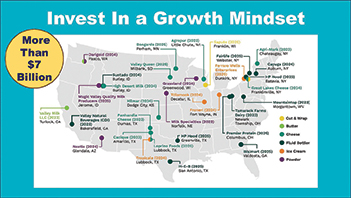
(IDFA) Dairy Forum in January, I posted a map showing more than $7 billion in ongoing or planned investment in U.S. dairy processing capacity across the country. The map turned a lot of heads. Hundreds of attendees began snapping photos with their phones. The image turned up in various news reports. And dozens of Dairy Forum attendees stopped me in the halls to remark about the impressive growth occurring in U.S. dairy processing.
Some asked: Will we have the milk for all that new capacity?
As I noted in my remarks, we are experiencing one of the most exciting periods of investment and expansion in the history of dairy processing. Nearly three dozen projects spread across 16 states will modernize how the United States delivers milk, cheese, whey and ingredients, yogurt and ice cream to consumers here and abroad.
Since coming to IDFA in 2016, I have seen the best years of per capita dairy consumption in the United States as well as the strongest years for U.S. dairy exports in our nation’s history. In other words, U.S. dairy is firing on all cylinders.
Consumers are embracing fuller-fat dairy once again. Cheese, butter and premium ice cream have become staples in American homes. At the same time, dairy ingredients are central to foods and beverages powering America’s health and fitness trends. High-protein, extended-shelf-life and lactose-free milk are reenergizing the fluid case. Yogurt and cultured products are on the menu throughout the day as mains and sides as well as garnishes and ingredients.
We’re also reaping the benefit of growing cheese production with significant innovation in byproducts like whey. There is more whey going into dried products, powders and shakes — and turned into high-value spirits like vodka and whiskey as well as ethanol for transportation fuel — than ever before. It’s quite possible that in five years, you will be riding on a city bus powered by the natural gas collected from manure and driving a car powered by a milk byproduct.
This is a new vision for dairy, and it requires new investments. That is why we are seeing billions of dollars in dozens of new processing facilities across the country. State-of-the-art cheese, whey and ingredients plants are being built in places we haven’t traditionally associated with dairy, like Kansas, Texas and Nebraska, while former dairy hubs, like upstate New York, are seeing a resurgence.
Although USDA is forecasting slightly lower milk production growth through 2030, production is increasing and milk is changing to meet consumer demands for more fat and protein to make the products people love, like cheese, yogurt and butter.
By 2030, the average dairy cow is projected to produce 26,295 pounds of milk, up from 13,000 pounds in 1960. U.S. dairy is the clear global leader in efficiency metrics.
Our dairy herds are evolving, too, with Jerseys alongside the Holsteins. And farms are evolving, as we see a shift to larger operations to benefit from economies of scale and enhanced competitiveness in markets.
According to USDA data, 9% of today’s dairy farms are milking 65% of the cows. This is pure cost management. On a per-hundredweight basis, large farms face 12% lower feed costs and 20% lower operating costs than smaller operations, according to Rabobank. They are also able to invest in people in different ways — creating specialized positions for technology, genetics, sustainability and animal care.
As farms adapt for the marketplace, dairy’s business model continues to evolve. While small operations are innovating with direct-to-consumer models prized for quality and artisanal products, larger operations are building a reputation for delivering consistent, high-quality milk with reliable sustainability metrics.
This is the beginning of dairy’s free agent era. It is true that dairy cooperatives own about two-thirds of the processing capacity in the U.S., but I think that we will see large farms vertically integrate their dairying with feed crop production and dairy product manufacturing. These operations will be early adopters of technology and adapt quickly to the continuously evolving demands of the marketplace.
Global demand for U.S. dairy products is expected to grow over the next 10 years. Per capita consumption of U.S. dairy will continue its upward trend, too, as consumers embrace dairy for its all-around goodness and health. Modern facilities requiring fewer workers will replace the older, less efficient processing plants. Dairy operations will continue to migrate toward expanding processing capacity.
In other words, the future we’ve talked about and planned for decades is finally here.
CMN
The views expressed by CMN’s guest columnists are their own opinions and do not necessarily reflect those of Cheese Market News®.
| CMN article search |
   |
|
|
© 2026 Cheese Market News • Quarne Publishing, LLC • Legal Information • Online Privacy Policy • Terms and Conditions
Cheese Market News • Business/Advertising Office: P.O. Box 24 • Sun Prairie, WI 53590 • 608/831-6002
Cheese Market News • Editorial Office: 5315 Wall Street, Suite 100 • Madison, WI 53718 • 608/288-9090