 |
|||

|  |

|
|
Guest Columns
Perspective:
Dairy Markets
Where will the milk come from?
Mike McCully
Mike McCully is owner of McCully Consulting, South Bend, Indiana, and contributes this column for Cheese Market News®.
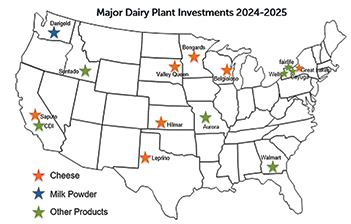 |
There is over $5 billion in new milk processing capacity currently under construction in the U.S. That is a strong signal that companies are willing to invest significant amounts of money to supply a growing demand for dairy products in both the domestic and export markets. This also stands in contrast to Europe and Oceania, where little new investment is taking place as future milk growth is limited. While this is an exciting time for the U.S. dairy industry, the wave of investment has raised a number of questions.
The first question being asked is, “Where will the milk come from?” Milk production has been below year-ago levels for the past five months (July-November) with continued contraction of the nation’s dairy herd and flat to lower milk per cow. However, the U.S. total has been pulled down by large losses in California, Texas and New Mexico. Milk in other key regions including the Upper Midwest, Mideast and New York has been growing, which will help fill capacity at new plants in those areas.
The biggest question on future milk growth is the Southwest and how new plants in that area will get the milk they need. There are reportedly several farm expansions occurring in west Texas, but New Mexico production continues to fall sharply. Water remains a long-term concern for the region, with some predicting water availability will curb any future growth of farms and milk. This is the one area of the country that could struggle to increase milk supplies to meet the new demand and could see a shift of milk out of milk powder and balancing plants in the region, causing some plants to lose milk. Increased competition for milk will help farmers as premiums will likely move higher. This will be the key area to watch.
Once the plants get the milk, then the question becomes, “Where is all of the product going to go?” The biggest impact is in cheese and whey given multiple new plants starting up about the same time. In total, the new cheese production would represent a nearly 6% increase in production, or triple the average annual increase. The net increase is likely less than that as some plants fall out of the system. Given the new cheese is mainly in commodity styles, lower prices will be needed to incent buyers and regain market share in the export market. In several years, the market is expected to get back into balance as demand catches up with the new supply, but until then, prices and premiums for cheese could be depressed. Timing is everything, and if demand is stronger going into 2025, it might be easier to clear the new cheese than currently envisioned.
The whey markets will also be impacted as most of the production will be in whey protein concentrate (WPC) 80 and whey permeate. Some of the new plants could start with sweet whey powder and transition to WPC and whey permeate over time, which would lessen the impact to prices.
With only one new plant, the impact to butter and milk powder markets is more modest. While there could be some loss of milk from butter-powder plants in some regions, the new Darigold plant could make up the difference. The net impact might end up being bullish for butter and milk powder prices depending on how much milk the balancing plants lose. This will also impact cream markets with the potential for tighter markets and higher multiples in the Southwest, but with the reverse impact in western New York and the Upper Midwest.
Maybe less discussed are the changes occurring in fluid milk with multiple new plants producing extended-shelf-life beverages. Several of these plants are located around the edge of the Southeast, where local milk supplies are falling. These plants are well positioned to take advantage of growing demand in that area in the future. Another plant investment that recently made headlines is the new Walmart fluid milk plant in southern Georgia. Unlike other Southeastern states, Georgia has seen milk growth in the last decade, and Walmart will be able to source from large farms in that area. The combination of new processing capacity and declining fluid milk consumption will further the trend of plant consolidation.
While the overall growth story is a positive one for the U.S. dairy industry, there will be winners and losers.
With the growth in commodity products, lower prices will likely be needed to clear product. This will cause pain for dairy farmers through lower milk prices, although partly offset in some areas by higher premiums. The long-term trend of fewer, larger farms is expected to continue to accelerate with mid-sized farms finding it harder to compete with large, lower-cost farms while at the same time not being able to maximize payments through the Dairy Margin Coverage program. In early 2019, my prediction was that dairy farm numbers would decline over 50% by 2030 to around 20,000 farms. Now, that looks optimistic with current projections closer to 18,000 farms or fewer by 2030.
Just as with farms, mid-sized dairy plants with higher cost structures producing commodity products will struggle in this new environment. Some plants are already looking at changing their product mix or making other changes to bolster their business. Other plants will close as consolidation will not only occur at the farm level.
While it is easy to get down about current milk or dairy prices, the long-term future for the U.S. dairy industry seems bright. Long-term trends are positive for dairy demand, and with limited supply growth in major export regions, the U.S. dairy industry is well positioned to take advantage of those trends. Companies are investing in growth and producing products consumers are demanding. The challenge for dairy farms and plants will be to determine how their business can prosper in this growing industry.
CMN
The views expressed by CMN’s guest columnists are their own opinions and do not necessarily reflect those of Cheese Market News®.
| CMN article search |
   |
|
|
© 2026 Cheese Market News • Quarne Publishing, LLC • Legal Information • Online Privacy Policy • Terms and Conditions
Cheese Market News • Business/Advertising Office: P.O. Box 24 • Sun Prairie, WI 53590 • 608/831-6002
Cheese Market News • Editorial Office: 5315 Wall Street, Suite 100 • Madison, WI 53718 • 608/288-9090