 |
|||

|  |

|
|
U.S. dairy industry invests billions in plant expansions, innovation
Editor’s note: Plants in Progress is a special segment spotlighting new facilities and expansion in the U.S. dairy sector — from initial groundbreaking to full operation and everything in between.
By Alyssa Mitchell
MADISON, Wis. — This National Manufacturing Month, U.S. dairy is in the spotlight for the billions in investment companies are putting into plant expansions, improvements, new processing facilities and product innovation across the country.
Last week, the International Dairy Foods Association (IDFA) released a new analysis that shows America’s dairy processors are investing more than $15 billion in new and expanded manufacturing capacity across 23 states, with more than 85 projects planned or underway through 2030.
The investments span nearly every major dairy category and include new plants, facility expansions, additional processing lines and modernization projects. They reflect strong confidence in the future of U.S. dairy as companies add capacity to produce more high-protein, nutrient-dense dairy foods to meet growing domestic demand and expand export opportunities.
“America’s dairy industry is investing for growth,” says Michael Dykes, IDFA President and CEO. “More than $15 billion in new capacity and modernized facilities and economic opportunity for communities across 23 states. Dairy companies are putting capital to work because they see growing demand for dairy foods in the U.S. and around the world.”
In our biannual Plants in Progress special segment, we provide a glimpse into several of these projects, from increased investment into the cottage cheese consumer demand boom, to specialized dairy proteins, to flavorful cheeses and yogurt.
Please read on for more on these Plants in Progress ...
|
| Photo courtesy of Actus Nutrition |
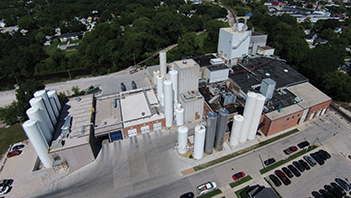
| MORE POWDER, PLEASE — A major expansion at Actus Nutrition’s Fond du Lac, Wisconsin, facility, adds 40 million pounds of annual whey powder production capacity. |
• Actus Nutrition, Fond du Lac, Wisconsin
Actus Nutrition in August completed a major expansion and infrastructure modernization project at its Fond du Lac, Wisconsin, facility. The investment adds 40 million pounds of annual whey powder production capacity while further strengthening the company’s position as a leading global supplier of dairy nutrition ingredients.
The investment enhances Actus Nutrition’s ability to meet growing customer demand for the portfolio of products produced at the facility through the implementation of advanced manufacturing technologies, including next-generation robotics, automation systems and process improvements designed to increase efficiency, product quality and operational scalability, officials say. The project included significant upgrades to drying operations, liquid management capabilities and carbohydrate processing systems.
“This expansion represents continued investment in our people, our capabilities and the future of dairy nutrition manufacturing in Wisconsin,” says David Lenzmeier, CEO of Actus Nutrition. “By combining advanced automation technologies with critical infrastructure improvements, we are increasing our capacity to serve customers while strengthening our long-term competitiveness.”
In addition to expanding production capacity, the project is creating new full-time positions to provide additional leadership and career advancement opportunities for current employees. More than 100 contractors worked alongside Actus Nutrition team members and project partners to complete the multimillion-dollar initiative.
“This investment is about more than additional capacity — it’s about building a foundation for future growth,” Lenzmeier adds. “By modernizing key areas of the facility and investing in advanced automation technologies, we’re creating a more efficient, scalable operation that will help us better serve our customers, support our employees and strengthen our business for years to come.”
The Fond du Lac facility is one of Actus Nutrition’s flagship manufacturing locations and has been a cornerstone of dairy processing innovation for more than 100 years. Originally built in 1918, the facility has evolved to become North America’s largest whey protein isolate manufacturing site, according to the company. Today, it produces a broad portfolio of whey-based ingredients, including whey protein concentrates, isolates, hydrolysates, sweet whey powder and specialty ingredients such as lactoferrin.
• Associated Milk Producers Inc., Portage, Wisconsin
Equipment installation is underway at Associated Milk Producers Inc.’s (AMPI) Blair, Wisconsin, plant as the facility transitions from Cheddar to cottage cheese production. The project remains on schedule, with completion slated for early 2027.
During the transition, milk from AMPI member farms is being redirected to surrounding plants, while other AMPI cheese plants continue filling customer orders. Once operational, the Blair facility will be among the largest cottage cheese production plants in the United States.
Meanwhile, rebuilding efforts at AMPI’s Portage, Wisconsin, plant following a January 2023 fire are complete, and production continues to ramp up. The rebuilt facility features expanded production and packaging capabilities, along with infrastructure improvements designed to increase efficiency and support long-term growth.
|
| Photo courtesy of Bel Brands USA |
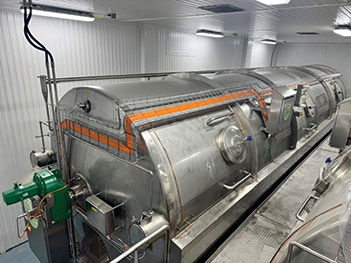
| GOGO SQUEEZ — Bel US earlier this month held a ribbon-cutting to unveil a major modernization project at its GoGo squeeZ manufacturing facility in Traverse City, Michigan. |
• Bel US, Traverse City, Michigan, and Brookings, South Dakota
Earlier this month, Bel US celebrated its continued investment into Michigan with the official ribbon-cutting of a major modernization project at its GoGo squeeZ manufacturing facility in Traverse City. The $11 million investment modernizing its apple processing capabilities represents a significant milestone for the site, delivering on better workflow for employees, strengthened production capabilities, and Bel’s long-standing commitment to Michigan’s apple growers. Since 2008, GoGo squeez has been the leading squeezable pouch made with fruit, veggie, dairy and other quality ingredients, officials say.
Completed after approximately three years of development, the upgrades to the GoGo squeeZ apple processing improve efficiency, capacity, safety and sustainability. The project benefits include unlocking 12,000 tons of increased annual production capacity; contributing to expected water savings of 22% due to new efficiencies; and improving lighting and ergonomics for employees.
Meanwhile, Bel in March broke ground on a $200 million expansion of its Babybel production facility in Brookings, South Dakota. The project will double the plant’s annual production capacity from 10,000 to 20,000 tons, marking a major milestone in the company’s 50-year presence in the U.S. market.
The investment will create around 150 new jobs and double milk sourcing from American dairy farms, primarily in South Dakota and neighboring states. It marks one of Bel’s largest manufacturing investments in the United States, supporting the company’s ability to meet sustained consumer demand for portion-sized dairy snacks.
“Babybel continues to see strong demand in the U.S., driven by consumers seeking convenient, portion-sized dairy snacks made with a few ingredients and delivering complete protein,” says Peter McGuinness, CEO of Bel North America, which includes Bel US. “Expanding our Brookings facility allows us to meet that continued demand while investing in American manufacturing, local jobs and the Brookings community.”
|
| Photo courtesy of Bongards Creameries |
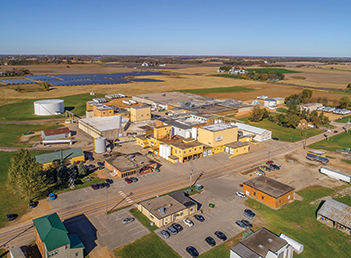
| BOOMING BONGARDS — Bongards Creameries is undertaking a $135 million expansion project in Bongards, Minnesota, to increase production capacity by an additional 180 million pounds of process cheese annually. |
• Bongards Creameries, Bongards and Perham, Minnesota
Bongards Creameries, one of the nation’s leading farmer-owned dairy cooperatives, this summer announced plans to invest $135 million to expand its process cheese manufacturing facility in Bongards,
Minnesota. The project represents one of the largest capital investments in the cooperative’s 118-year history and reinforces its long-term commitment to serving customers with expanded production capabilities, innovative dairy solutions and industry-leading quality.
The company recently broke ground and expects commercial operations to commence by early 2028.
Upon completion, the expansion will increase the facility’s production capacity by an additional 180 million pounds of process cheese annually, enabling Bongards to meet growing customer demand across the foodservice, retail, industrial ingredient and export markets. The investment will add approximately 120,000 square feet to the production facility, including approximately 50,000 square feet of additional production space and a 70,000-square-foot automated warehouse designed to support greater efficiency and future growth.
“This investment is about much more than expanding production capacity,” says Dennis Thomas, CEO of Bongards Creameries. “It demonstrates our commitment to remaining a world-class dairy manufacturer while strengthening the cooperative for future generations. As consumer demand evolves and global opportunities continue to expand, we are positioning Bongards to be the partner of choice for our customers and an enduring source of value for our member-owners.”
Beyond increasing production capacity, the investment is expected to generate significant economic activity throughout the region during construction and create long-term operational opportunities that will benefit the local community, cooperative members, suppliers and business partners, officials say.
Meanwhile, Bongards Creameries also recently completed a $125 million plant expansion announced in 2023 at its Perham, Minnesota, facility. The expansion/modernization project included new cheese vats, a new whey pasteurizer, a new permeate evaporator, a new milk intake and a new deproteinized whey dryer/permeate packaging system/permeate warehouse. Total square footage of the plant after the updates is 288,000 square feet.
• Chobani LLC, Twin Falls, Idaho; Norton Shores, Michigan; Rome, New York; and Allentown, Pennsylvania
Chobani last month announced plans to invest approximately $1.2 billion over the next five years in a world-class, 1.5-million-square-foot manufacturing and warehouse campus in Allentown, Pennsylvania, creating more than 900 jobs and establishing a major new hub for the company’s growth.
As part of an expanded partnership with Keurig Dr Pepper (KDP), Chobani has acquired its Allentown manufacturing facility and warehouse, including its equipment and related infrastructure. First opened for production in 2021, the state-of-the-art facility provides an ideal starting point for Chobani to build on with new equipment, technology and production capabilities, company officials say.
In Allentown, Chobani will build on 20 years of dairy expertise to make more from farm-fresh milk, creating milk with more protein and less sugar than traditional milk. It will be available as a multiserve milk for families and serve as the foundation for a new generation of dairy products, including high-protein shakes made with real ingredients.
“When I first walked through this factory, I knew there was something special here. The facility, the equipment, the scale, but most importantly, the people. There’s already an incredibly talented team here that knows how to make great food. The foundation is strong. And we have an opportunity to build something extraordinary on top of it,” says Hamdi Ulukaya, founder and CEO of Chobani.
At full capacity, the Allentown facility is expected to source more than 3 billion pounds of Pennsylvania milk annually.
Key local partners include the Lehigh County Authority, Upper Macungie Township, Lower Macungie Township, South Whitehall Township and the city of Allentown.
The Allentown transaction also is part of a broader strengthening of the relationship between Chobani and KDP, including Chobani taking over operations at the Allentown facility, the repurchase of KDP’s equity stake in Chobani and an expanded distribution partnership. KDP’s company-owned direct store delivery network reaches approximately 80% of the U.S. population, creating significant opportunities to bring Chobani products to more consumers across the country.
KDP will retain some current employees at the facility, while all others will receive offers to join Chobani, providing continuity for employees and their families.
“These transactions reflect the success of our partnership with Chobani and are designed to create value for both organizations,” says Tim Cofer, CEO at Keurig Dr Pepper. “Together, they enhance our financial flexibility, strengthen the efficiency of our manufacturing network and support the expansion of our important distribution partnership with Chobani. This change also positions the Allentown facility for continued growth under an owner whose strategic priorities are well matched to the site, while ensuring continuity for our brands, customers and employees.”
The Allentown project is part of more than $4 billion Chobani is investing across its U.S. manufacturing network to build the capacity and capabilities needed for its next chapter of growth. Alongside Allentown, Chobani is investing in a new dairy processing facility in Rome, New York; expanding its manufacturing operation in Twin Falls, Idaho; improving its original site in New Berlin, New York; and expanding its Norton Shores, Michigan, facility, which produces La Colombe coffee beverages.
|
| Photo courtesy of Wisconsin Cheese Makers Association |
| INFRASTRUCTURE IMPROVEMENTS — Dairy State Cheese is celebrating the completion of a $150 million, multiyear modernization project at its Rudolph, Wisconsin, facility. Pictured above, from left, are John Umhoefer, executive director of the Wisconsin Cheese Makers Association; John Zirbel, chief operating officer of external manufacturing at Cheese Merchants; and Randy Romanski, secretary of the Wisconsin Department of Agriculture, Trade and Consumer Protection. |
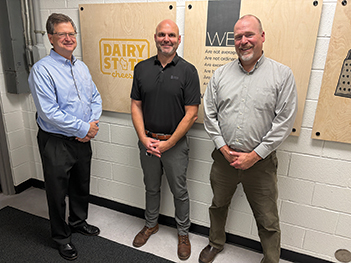
• Dairy State Cheese LLC, Rudolph, Wisconsin
Dairy State Cheese recently completed a $150 million, multiyear modernization project at its Rudolph,
Wisconsin, facility (owned by Cheese Merchants), which included upgrades to production and packaging operations, as well as a $21 million investment in wastewater treatment infrastructure. The project was completed over three years and included eight 55,000-pound cheese vats, six high-capacity 40-pound cheese block formers, two new whey separators and clarifiers, a UV water purification system and more.
Dairy State Cheese continues to make strong progress on several major capital projects designed to expand production capabilities and support future growth. John Zirbel, chief operating officer-external manufacturing, notes the recent installation of a new milk high-temperature short-time (HTST) system has strengthening the facility’s ability to efficiently process incoming milk. The facility also recently installed three new milk storage silos, each with a 70,000-gallon capacity. With the addition of these silos, total on-site milk storage capacity has increased to 480,000 gallons, providing greater flexibility in milk handling and production scheduling.
In the make area, the new cheese belt system is nearing completion of the installation phase and soon will transition into commissioning as the team prepares it for full production, Zirbel notes. Additional improvements also are taking shape in the plant’s processing systems, with new membrane equipment nearing the end of installation and commissioning expected to begin shortly.
Meanwhile, recently installed Alfa Laval separators and clarifiers already are in service and performing exceptionally well in day-to-day operations, Zirbel says. Dairy State Cheese also is investing in environmental infrastructure with work underway on a new wastewater treatment plant. The new system will be a state-of-the-art facility designed and integrated by Complete Filtration, supporting sustainable operations as the plant continues to grow.
• Danone North America, Fort Worth, Texas, and Minster, Ohio
Danone and PurposeEnergy recently partnered on an anaerobic digestion facility in Minster, Ohio, designed to convert yogurt manufacturing waste and wastewater into renewable energy.
Located on Columbia Drive in the Route 66 Industrial Park, the PurposeEnergy-Minster facility represents an investment of more than $40 million and is the company’s first project with Danone.
Designed to process up to 250,000 gallons per day, the project is expected at full operation to produce about 50,000 MMBtu (million British thermal units) of renewable biogas per year. That biogas is piped to a dedicated boiler at Danone’s Minster plant, where it displaces conventional natural gas. Using standard EPA/EIA combustion emission factors, this is equivalent to displacing approximately 3,200 U.S. tons of carbon dioxide equivalent per year.
“The PurposeEnergy facility is an example of our Danone Impact Journey in action and part of our wider Re-Fuel energy excellence program, helping turn organic material from our Minster plant into renewable biogas that can be piped back to the plant and used through a new biogas boiler,” says Heiko Gerling, chief operating officer of Danone Americas. “What makes this project especially meaningful is how it brings together industry, local infrastructure and community stakeholders around a shared goal. It is a powerful example of how operational growth and environmental stewardship can go hand in hand.”
Danone North America also recently invested $4 million in a remodel and expansion of its yogurt facility in Fort Worth, Texas. The expansion includes 3,495 square feet of additions and the remodeling of 1,8434 square feet in its existing facility to accommodate new equipment. The Fort Worth facility produces Danimals Kids’ Yogurts and Smoothies, Activia Probiotic Yogurt and YoCrunch Yogurt with Toppings. Approximately 210 employees currently work at the plant.
|
| Photo courtesy of Dari Processing LLC |
| IN DEMAND — Dari Processing LLC’s new ultrafiltered aseptic dairy processing plant in Seward, Nebraska,. is set for an April 2027 completion date. Officials say some of the plant’s additional capacity already is booked due to strong demand for this type of processing in the United States. |
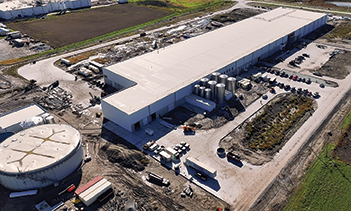
• Dari Processing LLC, Seward, Nebraska
Progress continues on Dari Processing LLC’s new 250,000-square-foot manufacturing plant in Seward, Nebraska, which broke ground in 2025. The plant is on schedule to open in April 2027, with full commercial production coming online in July, company officials say.
The new facility, an ultrafiltered aseptic dairy processing plant with both cold chain and ambient capabilities, is expected to process 1.8 million pounds of milk per day when it reaches full capacity in the coming years. The company anticipates hiring the equivalent of 70 full-time positions at the dairy plant.
Combining multiple stages of production in Nebraska at a strategic location along Interstate 80 will allow the company to maximize its resources.
The company’s PET bottle lines can fill pack sizes between 8 to 60 ounces, with an 8-ounce Tetra Pak filler as well, and Dari Processing has room for more fillers as its operation grows, officials say. It also can process milk protein concentrate. The facility also has formulating capabilities using batching systems, with plans for a full in-house innovation lab to help its customers develop new custom products.
T.J. Tuls, co-CEO of Dari Processing, notes that some of the plant’s upcoming capacity already is booked as there is strong demand for this type of processing in the United States.
“Our Midwest location is unique,” Tuls says. “It’s been a privilege to work on a project of this size. We’re looking forward to bringing an ultrafiltration plant to the American Midwest. We’re excited to get this plant up and running in 2027.”
• Edible Garden, Webster City, Iowa
Edible Garden AG Inc. recently announced it has entered into a Real Estate Purchase Contract to acquire a Webster City, Iowa, property that is being developed as the company’s Prairie Hills ready-to-drink (RTD) manufacturing facility. Under the agreement, Edible Garden will acquire the property from Iowa Shrimp Holdings LLC, which includes the real estate, buildings and improvements, as well as specified equipment, fixtures and other property associated with the site. Upon completion, the acquisition would transition Edible Garden from tenant to owner of the Prairie Hills property, providing the company with long-term control over a strategic manufacturing asset that is expected to play a key role in the continued expansion of its farm-to-formula platform.
Edible Graden offers plant- and whey-protein powders (such as Vitamin Whey), and is expanding into RTD clean-nutrition and protein beverages.
The acquisition would further align Edible Garden’s ownership of the property with the investments being made to establish Prairie Hills as a scalable RTD manufacturing platform. The facility is being developed to support commercial production across protein, functional wellness and other clean-label nutrition categories, including both Edible Garden branded products and private-label manufacturing opportunities. The company’s previously announced plans contemplate large-scale production of shelf-stable nutritional beverages and significant private-label opportunities at the facility.
“Our vision for Prairie Hills extends well beyond any single product or customer. We are building a flexible manufacturing platform designed to support clean-label, functional and protein-based beverages on a commercial scale,” says Jim Kras, CEO of Edible Garden. “We believe ownership of the facility would strengthen that platform, provide greater operational flexibility and establish an important long-term foundation for the development and commercialization of higher-value, shelf-stable nutrition products.”
Prairie Hills is designed to extend Edible Garden’s vertically integrated capabilities beyond its established fresh-produce operations and further into value-added consumer products and nutrition. This summer, Edible Garden announced the successful completion of its clean-label RTD prototype production run at Tetra Pak’s New Product Development Center.
|
| Photo courtesy of fairlife LLC |
| CHEERS TO FAIRLIFE— New York Gov. Kathy Hochul, third from right, along with local partners and fairlife executives, this summer celebrated a soft opening of fairlife’s flagship Northeast facility in Webster, New York. |
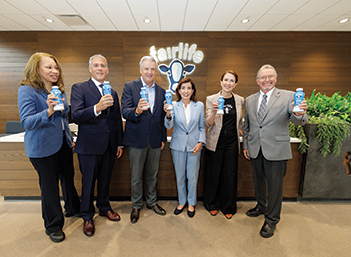
• Fairlife LLC, Coopersville, Michigan, and Webster, New York
The Coca-Cola Co. this summer celebrated the groundbreaking for a $650 million project that will expand the fairlife production facility in Coopersville, Michigan.
Becca Kerr, fairlife CEO, was joined by Michigan Gov. Gretchen Whitmer to commemorate the milestone. Coopersville Mayor Brian Mooney, Lakeshore Advantage Interim President Mandy Cooper and other elected officials and local leaders also attended.
“Our Coopersville plant has long been a powerhouse for the fairlife business, and this investment represents our largest expansion of the facility to date and our commitment to continuing to grow in Michigan by adding approximately 200 full-time jobs,” Kerr says. “The expansion will allow us to bring in an additional 4 million pounds of milk from Michigan dairy suppliers each day and significantly increase capacity and availability of fairlife products.”
The fairlife plant in Coopersville began production in 2012 and currently employs nearly 450 full-time workers. The expansion project is expected to be completed in early 2028.
The company also is in the final stages of completing a new 760,000-square-foot production facility in upstate New York. This summer, fairlife celebrated the Webster, New York, facility’s soft opening with a ribbon-cutting ceremony featuring guests including New York Gov. Kathy Hochul and the local partners that have been instrumental in this project.
The Webster plant, which is expected to be fully operational later this year, will be fairlife’s flagship Northeast facility in the United States. In addition to significantly increasing the availability of fairlife products across the country, the new plant already has created approximately 380 full-time local jobs and is sourcing milk daily from more than 40 local dairy farms.
|
| Rendering courtesy of GEA |
| GEA GROWTH — Pictured above is a rendering of the planned expansion of GEA’s Janesville campus in Wisconsin, adding production, testing, training and application capabilities for North American food and beverage customers. |
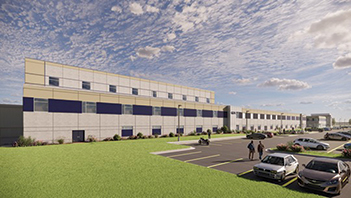
• GEA, Janesville, Wisconsin
Following approval of a development agreement with the city of Janesville, GEA is moving ahead with the expansion of its Janesville campus in Wisconsin, strengthening local production and technology capabilities for food, beverage and nutrition customers in North America, the company announced earlier this fall. The new building will add around 70,000 square feet of office, manufacturing, research and industrial space, representing an investment of about $25 million in construction, machinery and equipment. The facility is scheduled to become fully operational in early 2028.
The new space brings GEA’s manufacturing, assembly and application teams closer together at Janesville. For customers, that means direct access to GEA experts on-site, shorter turnaround between a test result and a production decision, and less time lost moving a process from the lab to the plant floor.
“Food and beverage producers in North America are looking for partners who can combine process expertise, practical testing and reliable project execution close to their markets,” says Klaus Stojentin, CEO of GEA’s Nutrition Plant Engineering Division and member of the GEA executive board.
“Expanding our Janesville campus is a direct response to that. It builds real capability in a region that matters strategically to both our customers and to GEA.”
The expansion also will contribute to the local economy in Janesville. The city of Janesville’s development agreement references 52 living-wage-equivalent positions as part of the project framework. City representatives say that, with this expansion, GEA will have invested around $75 million in Janesville since the first Tax Increment Financing agreement in 2022.
|
| Photo courtesy of Hiland Dairy Foods |
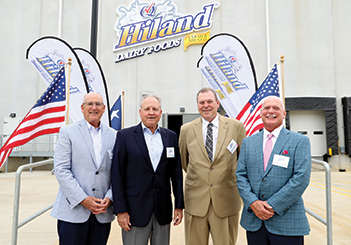
| RIBBON-CUTTING — Hiland Dairy officials including, from left, Shawn Pinon, senior vice president, Hiland; Gary Aggus, former president of Hiland (retired) and consultant; Barry Beaman, general manager of Hiland; and Rick Beaman, president of Hiland, joined state and local officials this spring for a ribbon-cutting celebrating the completion of the company’s new production facility in Tyler, Texas. |
• Hiland Dairy Foods Co., Tyler, Texas
Hiland Dairy executives joined state and local officials this spring for a ribbon-cutting ceremony marking the opening of the company’s new production facility in Tyler, Texas. Hiland Dairy first announced the 90,000-square-foot expansion in 2024. The project encompassed state-of-the-art processing, filling, casing and palletizing upgrades as well as a new laboratory.
“This expansion is more than just growth in our physical footprint; it’s a commitment to the future of Tyler,” says Rick Beaman, president of Hiland Dairy. “We deeply appreciate the support we’ve received from the city, and we’re excited to continue providing good-paying, stable jobs for this community for years to come.”
Big-D Construction served as the general contractor for the project, and design was by E.A. Bonelli Architects + Engineers.
“This expansion is a testament to our commitment to the community and our dedication to maintaining the highest standards in dairy production,” adds Barry Beaman, general manager at Hiland. “We look forward to continuing our legacy of excellence with this new investment.”
• HP Hood, Sacramento, California; Winchester, Virginia; and Batavia, New York
HP Hood LLC earlier this month broke ground on two projects at its Sacramento, California, manufacturing facility that will expand cold storage and packaging capabilities in support of the company’s extended-shelf-life (ESL) and aseptic beverage business.
The first project will add a 40,000-square-foot cold storage facility to the company’s existing Sacramento manufacturing site. With capacity for more than 20,000 pallets, the facility will use automated mobile robots (AMRs) to transport pallets from production to the storage silo. Eighteen distribution lanes will serve nine outbound loading docks. Operations are expected to begin in 2028.
The second project is a 30,000-square-foot blow molding facility that will supply plastic packaging to the plant. Operations are scheduled to begin in late 2027.
Progress also continues on an expansion at HP Hood’s Winchester, Virginia, manufacturing facility. The plant will encompass 442,000 square feet when the expansion is complete.
HP Hood also previously announced that its Batavia, New York, manufacturing plant was approved for a $25 million expansion to its milk receiving bay. The 7,772-square-foot expansion will improve the processing capabilities of the Batavia plant and increase the overall fluid capacity of the facility. The improvements include a two-bay raw milk silo alcove and room for four silos, along with additional facility upgrades.
• Idaho Milk Products, Jerome, Idaho
Idaho Milk Products in late May celebrated the ribbon cutting of its new ice cream and powder blending facility in Jerome, Idaho. Designed with advanced technology and precision processing, the new integrated facility combines large-scale production capabilities with the flexibility to meet diverse customer needs across both retail and foodservice markets, bringing together high-speed ice cream manufacturing and high-capacity powder blending within a single facility.
The facility supports a wide range of production capabilities — from premium ice cream novelties to bulk formats and custom dairy formulations. Idaho Milk Products can produce up to 54,000 novelty ice cream items per hour, including stick bars, sandwiches and cones, with options for variegates (swirls), inclusions and dual coatings. In addition to novelties, the plant offers high-capacity bulk manufacturing, producing up to 14,400 pints per hour or 7,200 48-ounce containers per hour. Flexible packaging options range from 3-ounce servings to half-gallon containers, allowing for tailored solutions that meet precise customer specifications.
Complementing its ice cream capabilities, the facility features advanced dry blending systems capable of processing up to 16,000 pounds per hour, delivering consistent dairy-based ingredient solutions tailored to specific food applications.
“After years of planning, this new facility enables us to advance our milk protein powder business through customized blending solutions while bringing the same value-added approach to cream as we have with milk protein. More importantly, this is a plant built for the future,” says Idaho Milk Products CEO Daragh Maccabee.
• Lactalis USA/Canada, Ingleside, Ontario; Tulare, California; and Buffalo, New York
While Lactalis USA has ongoing expansions in California and New York, Lactalis Canada, the Canadian dairy leader behind brands including Cracker Barrel, Black Diamond, Balderson, Astro and Lactantia, officially opened its new R&D Centre in Ingleside, Ontario.
Located adjacent to Lactalis Canada’s cheese processing plant in Ingleside, the R&D center features advanced pilot-scale capabilities and specialized testing and evaluation spaces designed to support product and process development.
The facility was officially inaugurated Oct. 20 with a ribbon-cutting ceremony and facility tour with Lactalis Canada executives and government and industry representatives.
Meanwhile, progress continues on a $55 million investment in Lactalis USA’s Tulare, California, facility that will allow the company to significantly increase the volume of Président Feta cheese produced in the United States.
The new 38,000-square-foot manufacturing line will bring additional capacity for Lactalis USA Feta production in the United States at its facilities in Tulare and Belmont, Wisconsin. The project creates 20 full-time positions at Tulare along with 100 temporary or contract positions during construction. The construction timeline spans from 2023-2027; when completed in 2027, Lactalis USA will have increased its U.S. Feta production capacity to address current and future customer and consumer demand.
Lactalis USA also has ongoing improvement projects at facilities in Buffalo and Walton, New York.
Lactalis has committed to invest $123 million in its Buffalo plant from the beginning of 2020 through the end of 2027. This includes a $60 million project to expand its Ricotta capacity, which encompasses the installation of six 50,000-pound vats, an advanced cheese belt, separators, silos and a robotic palletizer.
Lactalis has invested $15 million to modernize its Walton facility to expand its cottage cheese and sour cream production lines. Market demand for nutritious, high-protein foods is increasing, and this will enhance the company’s efficiency, capacity and sustainability, officials say. The project will include new fillers, HEPA air filtration, advanced lab equipment, new roofing and boiler upgrades.
The Walton plant produces Breakstone’s sour cream and cottage cheese.
• Land O’Lakes Inc., Tulare, California
Land O’Lakes Inc. this summer announced a strategic investment in its Tulare, California, dairy processing facility to expand capabilities into high-value dairy protein production, positioning the cooperative to meet rapidly growing global demand for protein-rich nutrition, while also creating new opportunities for its farmer-owners.
The investment will enable production of ultrafiltered milk, unlocking greater value from member milk, providing growth opportunities for farmer-owners and strengthening Land O’Lakes’ ability to compete in a changing food landscape increasingly centered on protein, company officials say.
“At a time when protein is reshaping how consumers eat and how the food system operates, this investment positions Land O’Lakes, our Tulare facility and our farmer-owners to lead,” says Heather Anfang, executive vice president of Land O’Lakes and president of Dairy Foods. “We are continuing to build a more resilient, growth-oriented dairy business while creating new demand for member milk and laying the groundwork for long-term opportunity.”
As a farmer-owned cooperative, Land O’Lakes is focused on maximizing value for its member owners. This investment creates new demand for member milk and the opportunity to maximize member returns by adding production for higher-value protein applications that support expanded market access and long-term cooperative growth, officials say. The investment also recognizes the strength of the Tulare-area dairy community, including about 100 dedicated, innovative farmer-owners and farm families whose operations help make the region one of the most important dairy-producing areas in the country.
The Tulare facility, located in one of the nation’s largest and most dynamic milk sheds, offers existing scale, available capacity and strategic access to global markets, including high-growth regions that rely on imported dairy protein.
• Leprino Nutrition, Lubbock, Texas
Leprino Nutrition, the specialty ingredient division of Denver-based Leprino Foods Co., this week announced completion of a $35 million expansion at its Lubbock, Texas, facility, quadrupling the company’s microparticulated production capacity. The additional capacity is incremental to Leprino’s current sweet whey operation and will focus on the consolidation of externally sourced whey solids. With this expansion, Lubbock joins Fort Morgan, Colorado, as one of Leprino Nutrition’s two facilities dedicated to microparticulated production.
Demand for protein-fortified food and beverage products continues to grow as consumers pursue dietary and nutrition goals across all categories. As brands push protein levels higher, many run into formulation challenges that impact taste, texture and stability, which can undermine a great consumer experience. Leprino Nutrition’s investment in Lubbock addresses that challenge by providing a specialty protein ingredient that works in complex formulas without compromising quality, officials say.
“This expansion allows us to bring meaningful volume to the market at exactly the moment the industry needs it,” says Angela Queneau, senior director of R&D at Leprino Nutrition. “Microparticulation is one of the most technically demanding and commercially promising formats in specialty protein today. With our investment in Lubbock, customers can benefit from advanced dairy science coupled with supply confidence to formulate ambitious, high-protein products.”
The centerpiece of the expansion is MP PRO C80, Leprino Nutrition’s microparticulated whey protein concentrate. Well-positioned for a wide range of applications, from puddings to desserts, baked goods, snacks, dips, dressings, sauces, ice cream and more, this ingredient helps formulators hit high-performance protein targets while preserving sensory quality.
With the Lubbock expansion, Leprino Nutrition is positioned to supply this in-demand format at a scale and level of reliability that reinforces its leadership in specialty proteins, backed by significant investment and manufacturing expertise.
• Lifeway Foods, Waukesha, Wisconsin
In a recent financial update, Lifeway Foods Inc. notes it entered the second half of 2026 with record first-half net sales of $129.9 million, significant new retail and foodservice distribution, and the planned completion of its transformative Waukesha expansion in early 2027.
“Together, these investments position Lifeway to reinforce its category leadership, serve growing demand and build long-term shareholder value,” says Lifeway late last year held a ribbon-cutting ceremony in front of Gertrude the Cow, the beloved landmark at Lifeway’s Waukesha facility to mark the launch of phase two of its four-phase, $45 million expansion project, a long-term investment designed to double overall production capacity, increase operational efficiencies, expand production hours and staffing, and solidify Waukesha’s position as the global hub of kefir production. Phase two focuses on installing a state-of-the-art cooling system to support Lifeway’s expanded fermentation and bottling operations.
Lifeway’s Waukesha facility transforms millions of gallons of Wisconsin-sourced milk each month into the company’s signature kefir, a tart and tangy cultured dairy beverage packed with protein, calcium and live probiotics.
The Waukesha expansion represents Lifeway’s largest manufacturing investment to date. When fully complete, the project will enhance the company’s ability to deliver high-quality cultured dairy products worldwide while strengthening Wisconsin’s position as a cornerstone of America’s dairy and probiotic industries.
• Marathon Cheese, Booneville, Mississippi
Marathon Cheese this summer announced it is expanding its manufacturing capabilities in Booneville, Mississippi. The project represents a $326,000 corporate investment and will create 39 jobs.
Marathon Cheese is a custom cheese packaging and transportation company headquartered in Marathon, Wisconsin. The expansion includes the installation of new manufacturing equipment, including a production line that will increase slicing and packaging capacity at the Booneville facility.
The Mississippi Development Authority is providing assistance through the Mississippi Flexible Tax Incentive, or MFLEX, program. Prentiss County, the city of Booneville and the Tennessee Valley Authority also are assisting with the project.
“Marathon Cheese began operations in Booneville, Mississippi, in 1962, and expanded its operations there by 3,500 feet the following year. In 2000, Marathon Cheese again expanded its operations in Booneville to a larger, more efficient facility. The current capital investment, which includes the installation of a new slice line and case packing equipment, substantially increases the manufacturing capabilities of the Booneville plant and is expected to result in the creation of 39 new jobs,” says Gary S. Bachand, president of Marathon Cheese. “Booneville offers both the infrastructure and workforce needed by Marathon Cheese for this strategic investment. We are delighted to be working with the Mississippi Development Authority, Prentiss County and the city of Booneville on the current project to increase manufacturing capabilities and greatly appreciate the support we have received.”
|
| Rendering courtesy of Meister Cheese |
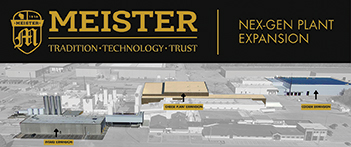
| NEXT-GEN EXPANSION — Meister Cheese this spring broke ground on the most significant investment in the company’s history. The “Next-Gen” expansion project will dramatically increase cheesemaking capacity at the company’s facility in Muscoda, Wisconsin. |
• Meister Cheese Co., Muscoda, Wisconsin
Meister Cheese in April broke ground on the next major phase of it “Nex-Gen” expansion project, a state-of-the-art facility where a century of tradition meets a new era of innovation for the family-owned cheese company.
Founded in 1916 by Joseph Meister, Meister long has been a pillar of the Wisconsin cheese industry.
Now, led by the fourth generation of the Meister family, this expansion marks the most significant investment in the company’s history. This milestone follows the successful completion of the project’s first foundational elements: a modern six-bay intake facility and an addition to the cold storage building. These completed structures set the stage for the highly anticipated next phase of the project — the expansion of a world-class cheese plant and whey processing capabilities.
The project will dramatically increase cheesemaking capacity, allowing the company to meet the growing global demand for its award-winning cheese and whey products. Company officials note this expansion isn’t just about square footage; it’s about evolution. By integrating cutting-edge technology with time-honored techniques, the new facilities will enhance Meister’s ability to produce premium cheese for nationwide retail and foodservice partners.
“The Nex-Gen plant is a major milestone in our 110-year history,” says CEO Scott Meister. “This expansion allows us to grow our footprint in Muscoda while staying true to the quality and care that have defined our family business for four generations.”
Consistent with Meister’s industry-leading environmental efforts — including biomass energy systems — the new building will incorporate modern efficiencies to minimize its carbon footprint. The Nex-Gen facility also is expected to provide a significant boost to the Muscoda economy, creating new opportunities both for local farmers and workers.
Meister is collaborating with a trusted network of local partners known for delivering high-quality, large-scale commercial and industrial projects throughout the region. Their collective expertise ensures that the facility will be built with efficiency, functionality and future scalability at the forefront, Meister says.
The Nex-Gen expansion is estimated to be completed in early 2028.
Meanwhile, Mascoma Community Development (MCD) in September announced the closing of $15 million in New Markets Tax Credits financing to support the expansion and modernization of the manufacturing operations of Muscoda Protein Products LLP, an affiliate of Meister Cheese Co.
“We are grateful to Mascoma and Impact Seven for their support in providing both federal and Wisconsin State New Markets Tax Credits. As we undertake the largest expansion in our company’s history, this financing provides flexible capital that will help us achieve our long-term strategic goal of increasing cheese production while continuing to strengthen our partnerships with local farmer, customers and community,” Meister says.
• Miceli Dairy Products, Cleveland
Miceli Dairy Products and the International Dairy Foods Association (IDFA) welcomed Rep. Shontel Brown, D-Ohio, to Miceli’s Cleveland facility for a tour and roundtable discussion with dairy leaders representing IDFA member companies across the dairy supply chain.
The tour of Miceli’s Cleveland facility offered Brown a firsthand look at dairy manufacturing and the company’s ongoing investment in its operations. Miceli’s currently is undertaking phase I of a $128 million expansion at its Cleveland dairy processing facility. This investment will create 50 additional jobs, further strengthening Miceli’s contribution to Cleveland and Ohio. A multigenerational, family-owned and operated Italian cheese company, Miceli’s has made traditional Ricotta, Mozzarella and Provolone in Cleveland since 1949.
“As a family-owned dairy manufacturer, we understand firsthand the opportunities and challenges facing our industry. It was an honor to welcome Rep. Shontel Brown and fellow dairy industry leaders to Miceli’s ... for such a productive discussion,” says Maria Miceli, vice president of marketing at Miceli Dairy Products. “Events like this are an important reminder of what we can accomplish when manufacturers, industry partners and policymakers come together to support American dairy, strengthen our communities and create opportunities for future generations.”
|
| Photo courtesy of Michigan Milk Producers Association |
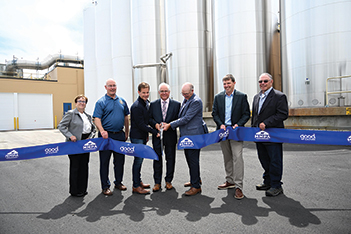
| A PLEASING PARTNERSHIP — Officials from the Michigan Milk Producers Association (MMPA) and Good Culture came together this summer to celebrate a partnership to produce cottage cheese at MMPA’s newly acquired facility in Remus, Michigan. |
• Michigan Milk Producers Association, Remus, Michigan
The Michigan Milk Producers Association (MMPA) hosted a ribbon-cutting ceremony this summer to celebrate the grand opening of its Remus, Michigan, processing facility and announced a new partnership with Good Culture to produce cottage cheese at the site. The milestone marks the official launch of operations at the facility MMPA acquired last year, expanding the cooperative’s processing capabilities and introducing cottage cheese to its product portfolio.
“This grand opening is an exciting moment for our cooperative and our member-owners,” says Joe Diglio, MMPA president and CEO. “With the launch of our Remus facility and our partnership with Good Culture, we are expanding our capabilities in a growing dairy category while continuing to invest in the future of dairy. This project reflects our commitment to innovation, strategic growth and delivering greater value for the farm families who own this cooperative.”
The Remus plant signals MMPA’s continued evolution as a dairy processor focused on building new markets for members’ milk. With investments in Remus and recent growth at its Ovid, Michigan, plant, MMPA is expanding its ability to meet changing consumer demand, grow with innovative customers and create long-term value for the dairy farm families who own the cooperative.
“We are proud to partner with Good Culture, a brand that shares our commitment to quality and innovation,” says Doug Chapin, MMPA board chairman. “This investment shows what can happen when member-owners put their confidence behind a shared vision. Together, we’re creating new markets for our milk, supporting our communities and helping deliver nutritious dairy products to more consumers.”
|
| Photo courtesy of Miller Family Dairy |
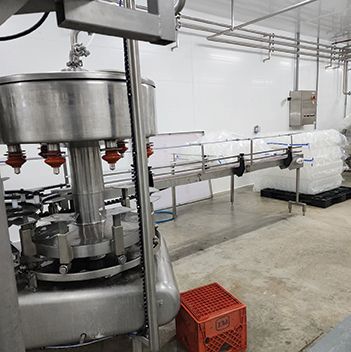
| UP AND RUNNING — Pictured above is Miller Family Dairy’s Grade A pasteurized nonhomogenized cream line milk, produced at its expanded facility in Russellville, Alabama. |
• Miller Family Dairy, Russellville, Alabama
Miller Family Dairy earlier this year completed a major expansion of its facility in Russellville, Alabama, that began in October 2024.
The first-generation farm, which opened in 2020 as a raw milk operation, currently milks eight cows and has grown its herd to about 100. The Alabama Department of Agriculture and Industries awarded Miller Family Dairy $1.9 million through the USDA Resilient Food Systems Infrastructure (RFSI) program, allowed the family to add pasteurization and begin producing value-added dairy products including butter and cheese.
“This grant opportunity completely changed everything for us,” says owner Jennilee Miller. “We saw an opportunity to not only expand into value-added dairy but also to support other dairy farmers in the area. According to the Dairy Alliance, only 16 dairy farms remain in Alabama. With our new facility, we hope to be able to change this.”
The project also provides space and resources for future growth, including sourcing milk from additional dairies, creating jobs and offering educational opportunities to promote Alabama’s dairy industry.
“Transitioning from raw milk production for our family to full-scale pasteurized milk for the community came with its own set of obstacles,” the company says. “However, the journey has been smoother than we expected. We’ve worked closely with milk inspectors to ensure every part of our facility meets the highest standards of safety and cleanliness.”
The facility includes specialized zones for cheese and butter production and a semi-automated bottling line capable of handling 500 gallons of milk every 30 minutes. A cheese vat produces 200 pounds of cheddar per batch.
With the opening of its store in February, milk, butter and cheese also are available directly from the farm, as well as in local stores.
• Nelson-Jameson, Turlock, California
Nelson-Jameson earlier this month announced a continuation of its investment with additional cold storage and logistics capabilities added at its Turlock, California, distribution center. This expansion is designed for optimized operational servicing, more robust inventory levels, reduced transit times, and streamlined deliveries for dairy producers across the West Coast. This project builds upon a cold chain infrastructure rollout at the company’s Fairview, Pennsylvania, distribution center in April.
Direct distribution from Turlock overcomes significant logistical hurdles associated with shipping cold-chain products over long distances, the company notes. To safeguard sensitive materials from heat, the Turlock facility features specialized ultra-low-temperature cold storage maintained at -60 C (-76 F). This ultra-cold capacity is specifically tailored for specialized cultures used in cheese manufacturing and fresh dairy products, such as those distributed through the company’s relationship with dsm-firmenich.
“This investment in Turlock represents a vital step in aligning our infrastructure directly with our West Coast customer needs,” says Brian Hanson, director of operations-West, at Nelson-Jameson. “By establishing these capabilities in California, we are eliminating transit vulnerabilities, protecting product quality and ensuring West Coast dairy processors receive the reliable service they count on.”
The Turlock site represents the next phase of a multiregion growth trajectory connecting operations from Fairview to Turlock, with plans to add culture storage in Jerome, Idaho, in the near future. The addition to the Idaho facility will serve customers across Idaho, Utah and the Pacific Northwest, expanding regional capacity and capability.
• Ninth Avenue Foods, Longview, Texas
Construction is underway with an anticipated November launch date for Ninth Avenue Foods’ new facility in Longview, Texas, which broke ground in July. The project had a $76 million initial construction cost, with a projected total capital investment exceeding $200 million over five years.
“Ninth Avenue Foods is committed to operating state-of-the-art manufacturing facilities that utilize advanced processing technologies. Our new site in Longview is strategically located to serve our existing customers while supporting our continued growth and expansion into new product capabilities,” says Steve Goldstein, vice president of Ninth Avenue Foods, which is based in City of Industry, California, with Midwest headquarters in Columbus, Indiana.
Goldstein notes after carefully researching and evaluating many communities across Texas, Ninth Avenue Foods selected Longview as its preferred location. The facility will utilize extended-shelf-life (ESL) clean-fill technology for private label and co-packing dairy and plant-based beverages.
“Working with Wayne Mansfield and Heather Malone of LEDCO (the Longview Economic Development Corp.) has been an outstanding experience and has reinforced our confidence that we’ve made the right decision,” Goldstein adds. “We’ve also greatly enjoyed getting to know the community and its many leaders. Selecting a site is never an easy task, but our experience in Longview has been exceptional. We look forward to being an active and valued partner in the community.”
|
| Photo courtesy of Novonesis |
| BIOSOLUTIONS — Novonesis recently celebrated the completion of a major expansion at its West Allis, Wisconsin, facility that increases its North American production capacity for dairy cultures. |
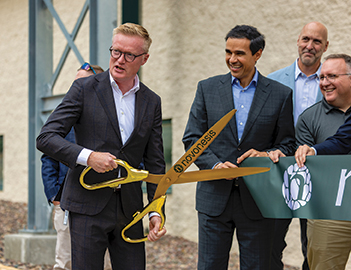
• Novonesis, West Allis, Wisconsin
Novonesis earlier this month announced the completion of a major expansion at its West Allis, Wisconsin, production facility. The investment increases the company’s North American production capacity for dairy cultures, boosting fermentation capacity by approximately 66% and packaging capacity by 17%, while establishing West Allis as one of the world’s largest lactobacillus production facilities. The additional capacity will allow Novonesis to help customers keep pace with booming consumer demand for more nutritious foods without compromising taste, texture or quality, while reinforcing Wisconsin’s role as a leader in dairy manufacturing and innovation, company officials say.
Novonesis celebrated the completion of the expansion with a ribbon-cutting ceremony attended by customers, employees, community leaders and industry partners. Guests toured the expanded production facility and customer experience center, highlighting the technologies and capabilities that will support the next generation of dairy manufacturing.
“For nearly a century, West Allis has played an important role in helping advance dairy innovation,” says Theis Bacher, senior vice president, food and beverage, Novonesis North America. “Today, it serves as our North American center of excellence for food cultures. This expansion builds on that legacy, strengthening our ability to continue delivering the biosolutions our customers rely on while investing in the people, manufacturing capabilities and technology that will help shape the future of dairy.”
While the current expansion adds new jobs and significant production capacity, the site layout allows for additional growth over time by leveraging existing infrastructure along with automation and robotics. The project also incorporates energy-efficient equipment, water reuse and waste heat recovery to reduce the environmental footprint of operations. Together, these enhancements expand Novonesis’ ability to produce the biosolutions food manufacturers rely on every day, helping customers improve how food is produced while supporting a more efficient, resilient bioeconomy.
|
| Photo courtesy of Sargento |
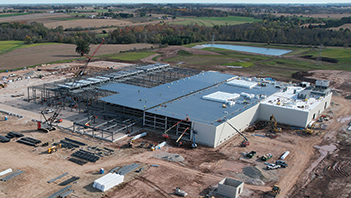
| CHUGGING ALONG —Construction is underway, including steel and walls going up, at Sargento’s new manufacturing facility in Plymouth, Wisconsin, which will feature the latest manufacturing technology and offer enhanced employee ergonomics. |
• Sargento, Plymouth, Wisconsin
Construction is underway on Sargento’s new manufacturing facility announced last year. The project marks the largest investment in the company’s history to accommodate its ambitious growth plans.
Sargento purchased 66 acres of land on Highway 57 and County Road PP in Sheboygan County, Wisconsin, where the new plant will be located. The initial plan is to relocate manufacturing operations from its current Plymouth campus to this new 384,000-square-foot facility, known as “G4”. Completion of the project and phased occupancy is anticipated to begin in 2027.
The company says with a vision to be the most innovative, best-loved real food company, this investment also demonstrates its commitment to the community and the future.
“G4 will have state-of-the-art manufacturing capabilities to help us meet, and exceed, our goals,” says Michael Pellegrino, chief operating officer, Sargento. “It builds on the terrific success of our past and gives us more opportunity to meet our customer needs for their and our long-term plans.”
The new facility will have the latest manufacturing technology and offer enhanced employee ergonomics. While the company does not anticipate new jobs to be created right away, this state-of-the-art facility will have more room to grow in the future, officials say.
• Schreiber Foods, Carthage, Missouri; Shippensburg, Pennsylvania; Logan City, Utah; and Beloit, Wisconsin
Schreiber Foods last month announced it will invest more than $267 million to expand its process cheese network by building a new manufacturing facility in Carthage, Missouri. The investment will help Schreiber meet growing customer demand while strengthening its ability to deliver the exceptional quality, food safety and service customers depend on.
The facility is expected to open in 2028 and create approximately 100 new jobs.
“Our customers’ ambitions help shape where we invest and how we grow,” says Trevor Farrell, president of Schreiber Foods. “This investment reflects our confidence in the future and our commitment to being ready for what’s next. By expanding our network in Carthage, we’re strengthening our ability to deliver the quality, food safety, service and reliability our customers count on every day.”
For more than 75 years, Schreiber has been a vital part of the Carthage community, currently employing more than 1,300 people across its existing facilities. This investment reflects the company’s continued commitment to Southwest Missouri and the people who call it home.
Meanwhile, Schreiber Foods late last year received official approval from the Shippensburg Borough Council for a conditional use application that paves the way for a $144 million plant expansion in Pennsylvania. Company officials say the investment will support Schreiber’s long-term goals to reduce water usage, increase yogurt production and grow its team with new full-time roles.
The approved plan includes an 18,000-square-foot addition to the south side of the plant in Shippensburg, a new 2,000-square-foot milk receiving dock and updated truck parking. Once complete, the expansion is expected to boost yogurt output by 100 million pounds annually and create approximately 50 new full-time positions.
Last year, Schreiber Foods also shared it has made investments to expand operations in Utah and Wisconsin.
Briohn Building Corp. of Brookfield, Wisconsin, last October broke ground on a project for a Milwaukee development company that will lease space in Beloit, Wisconsin, to Schreiber Foods. It is a two-phase project with room to add another 200,000 square feet as Schreiber Foods grows into the space.
Schreiber Foods entered into an agreement with Lyons Magnus to purchase the beverage plant in Beloit last year.
Meanwhile, the Utah Governor’s Office of Economic Opportunity (GOEO) awarded Schreiber Foods a post-performance tax reduction for an expansion in Logan City, Utah. The corporate incentive is part of the state’s Rural Economic Development Tax Increment Financing program.
Under the agreement, Schreiber Foods projects it will add 145 new, high-paying jobs and invest $165 million in Utah over the next eight years, GOEO says.
• Tetra Pak, Denton, Texas
Tetra Pak earlier this year announced the groundbreaking of a new facility at its U.S. and Canada headquarters in Denton, Texas, marking a significant expansion of its Product Development Center (PDC). This new investment will enhance Tetra Pak’s ability to support food and beverage brands as they ideate, formulate, launch and scale innovative products with greater speed and efficiency.
With a focus on collaboration and knowledge sharing, the PDC supports customer efforts to create new, profitable products and evaluate the equipment needed to produce them. The expanded PDC, scheduled to open in the first quarter of 2027, will encompass 12,000 square feet with an additional 3,000 square feet for a Customer Innovation Center (CIC). Often offered alongside a PDC, the CIC provides an immersive experience to apply experimental methodologies for co-creation. Together, these spaces will feature flexible meeting and co-creation areas designed to support deep collaboration with customers.
“Innovation is key to our customers’ success and (this) groundbreaking represents our continued commitment to helping brands move faster from concept to consumer,” says Seth Teply, president and CEO of Tetra Pak U.S. and Canada. “This investment expands our ability to support customers as they navigate complex product development challenges to avoid costly pitfalls, gain efficiencies and accelerate their path to market, all within a single expert-driven ecosystem.”
The expanded PDC and CIC will offer end-to-end support leveraging Tetra Pak’s global network of experts, technologies and testing capabilities. With a one-stop-shop model that integrates processing, packaging, formulation, testing and scaling expertise, customers will be able to streamline development timelines and confidently commercialize new products. The new space will double the current production capacity and is engineered to support rapid prototyping, optimization and hands-on co‑creation, helping brands respond quickly to consumer trends.
• Upstate Niagara Cooperative/UNC Dairy, West Seneca, New York
Construction is underway on a multimillion-dollar project that will significantly increase the size and capacity of Upstate Niagara Cooperative Inc./UNC Dairy’s West Seneca, New York, operations hub. The $325 million expansion of its yogurt and dairy manufacturing facility, originally pegged at $150 million when announced in July 2024, grew by after updated equipment costs and revised scope. Per the Erie County Industrial Development Agency project record, the building addition cost increased by more than $33 million and manufacturing equipment costs rose by $71 million, according to Westside Construction Group.
According to local news sources, this fall the project cost increased a third time to $325 million due to electrical needs.
Upstate Niagara, headquartered in Lancaster, New York, is one of the anchor tenants of West Seneca’s North America Center corporate and industrial park.
Officials say the expansion will result in Upstate Niagara increasing its employment at the West Seneca site. The project will “add significant manufacturing capacity and storage of finished products,” the company says.
Officials say the expansion project should be completed by the end of the year or in early 2027.
• Walmart, Robinson, Texas
Walmart this spring celebrated the grand opening of its third owned and operated milk processing facility in Robinson, Texas — a major milestone that will create more than 400 new jobs, strengthen Walmart’s end-to-end supply chain for affordable, high-quality milk, and advance the company’s long-standing commitment to U.S. manufacturing and local sourcing, officials say. The more than 300,000-square-foot state-of-the-art facility represents a more than $350 million investment.
Sourcing milk directly from local dairy farmers, the Robinson facility processes and bottles a variety of milk options — including gallon, half-gallon, whole, 2%, 1%, skim and 1% chocolate milk — for Walmart’s Great Value and Sam’s Club Member’s Mark brands. The new operation supplies more than 650 Walmart stores and Sam’s Clubs across the South Central United States, helping ensure customers and members have consistent access to high-quality, affordable milk.
This milestone follows the company’s investment in its first milk processing facility in Fort Wayne, Indiana, and its second milk processing facility in Valdosta, Georgia, which opened last year.
|
| Rendering courtesy of Washington State University Creamery |
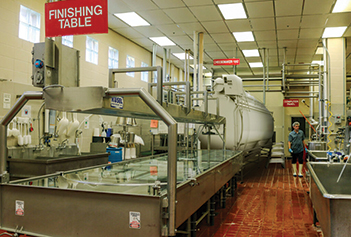
| UPGRADE AT WSU— The rendering above represents what the upgraded cheesemaking equipment and finishing table will look like after a $13.5 million upgrade at Washington State University Creamery. |
• Washington State University Creamery, Pullman, Washington
This summer, the Washington State University (WSU) board of regents approved a $13.5 million upgrade to bring the equipment currently used to make WSU’s beloved Cougar Gold cheese up to modern standards and increase cheese production.
Originally designed with a 20-year life expectancy, the current equipment has been in use since 1992. After 34 years of service, it is well beyond its expected lifespan.
“Our equipment has had a long and productive work life, but we need a refresh,” says John Haugen, WSU Creamery manager. “We can no longer get replacement parts quickly, and we’ve noticed some mild burning because the steam used in the cheese vat isn’t distributing properly.”
The burnt curds are removed before processing, which adds extra labor time and reduces the number of cans produced, he adds.
In addition to the vat, which will double in size from the current 15,000 pounds of milk capacity to 30,000 pounds, the creamery will replace its pasteurizer and finishing table.
“Everything was manufactured to process 15,000 pounds of milk,” Haugen says. “This upgrade will allow the entire system to meet modern standards and handle the increased processing amount.”
In addition to the new equipment, the creamery will upgrade its sanitation system by constructing a wall to more securely separate the incoming raw milk from the pasteurized product.
The creamery currently produces around 250,000 cans of its signature cheese every year. After the upgrade, it will produce 350,000 cans annually. That figure matches the capacity at the storage warehouse, where the cheese is aged for at least a year. A future project hopefully will boost storage capacity if more cans are needed.
Once a contractor is chosen, it can take up to a year for the vat to be ready for installation. Given that timeline, and to reduce impact on the busy season leading up to the holidays, the creamery won’t start the switchover until December 2027.
The plan is to shut down cheese production from then until March 2028, when the new system will start yielding delicious cans of Cougar Gold and other varieties.
“We are already increasing production,” Haugen says. “We do not want to run out of cheese, and it takes a lot of planning to prepare for a three-month shutdown.”
The funding for the upgrade will come mostly from the creamery itself. The state government is contributing $1 million, WSU is providing $2 million and there is hope for industry support on an upgrade that will help train their future employees. The remainder will come from the creamery’s reserves and a loan.
“This is a major investment,” Haugen says. “But when we are producing more cheese, we should be able to pay off the loan quickly and start building up our reserves again.”
|
| Photo courtesy of Wells Enterprises |
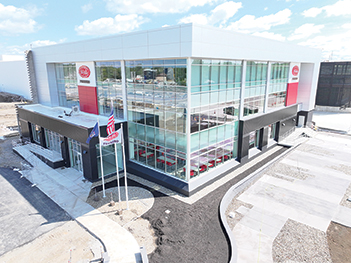
| BEST IN CLASS— Wells Enterprises in August held a ribbon-cutting event for its new, best-in-class employee center and production expansion in Dunkirk, New York. |
• Wells Enterprises, Dunkirk, New York
Wells Enterprises in August, celebrated a major milestone in its Dunkirk, New York, facility with a ribbon cutting for its new, best-in-class employee center and production expansion. The event highlighted the company’s continued investment in its people, products and the local community bringing together New York state leadership, county and community leaders, company leaders and employees to recognize the achievement.
Specifically, the milestone marked the completion of the first two phases of the $425 million facility’s state-of-the-art transformation. The new building, replacing an over 75-year-old structure, now includes updated breakrooms, cafeteria space, training rooms, offices and additional resources designed to support the team members who power Wells’ operations.
“This celebration reflects the people, partnerships and shared commitment shaping the future of Wells Enterprises in Dunkirk,” says Nicolas Neykov, chief operating officer at Wells Enterprises. “As we mark this next chapter of growth, we recognize our teams who are the heart of Wells. This transformation is more than an investment in equipment but reflects our commitment to supporting our skilled team with the resources needed to make the best ice cream and bring more joy to our consumers.”
In addition to the new employee center, the event also celebrated the startup of new production lines and capabilities that began late last year, including a first-of-tis-kind Segregated Compound Facility.
Combining Wells’ ice cream manufacturing heritage with Ferrero’s global confectionary leadership, the one-of-a-kind chocolate manufacturing facility is the only Ferrero facility of its kind in the United States and creates new capabilities for long-term category growth and future innovation. The plant also uses new proprietary technology and highly customized capabilities to meet rigorous standards and keep quality at the forefront of every cone, cup, pint and more.
Wells Enterprises purchased the Dunkirk facility in 2019 and broke ground in 2024 on the multiyear, multiphase transformation. This milestone marks the completion of phases one and two, including new infrastructure to support initial production lines, freezer capacity, the chocolate facility and the new employee center. Phase three, which currently is underway, will add more production lines, while phase four will expand processing capabilities, including raw materials. The full transformation is expected to be completed in 2028 and is expected to add 270 permanent jobs over the course of the next several years, while retaining existing roles. Once finished, the 350,000-square-foot facility will be capable of operating 11 to 15 production lines and producing an estimated 20 million cases annually, up from 4 million cases previously.
|
| Photo courtesy of Westby Cooperative Creamery |
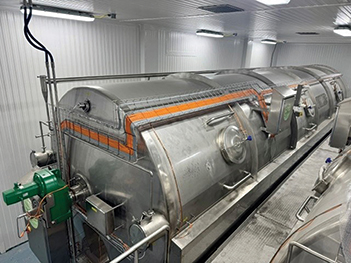
| NEW VATS— Westby Cooperative Creamery’s new multi cheese vats will operate within a fully enclosed system that reduces production time from 16 to eight hours. The vats also automate testing and sanitation and will provide an additional 7 million pounds of capacity at the plant. |
• Westby Cooperative Creamery, Westby, Wisconsin
Westby Cooperative Creamery last month celebrated the installation of its $14.1 million cottage cheese modernization equipment with a ribbon-cutting ceremony at its Westby, Wisconsin, manufacturing facility. The investment positions Westby to meet growing consumer demand while enhancing efficiency, food safety and long-term sustainability for its farmer-owned cooperative.
The project modernizes the creamery’s cottage cheese production system with state-of-the-art equipment designed around an enclosed-vat process, an entirely new method of manufacturing cottage cheese in the United States. The former open-vat system was highly labor-intensive and exposed the product to the environment. The new method enhances employee safety, production consistency and efficiency while reducing production time from 16 hours to eight hours.
“We’re proud to celebrate the completion of this investment and the future of Westby Cooperative Creamery,” says JD Greenwalt, president and CEO of Westby Cooperative Creamery. “This project allows us to replace aging equipment before it reaches the end of its useful life while giving us the capacity and technology needed to meet strong customer demand for cottage cheese. It strengthens our cooperative, supports our farmer-owners and ensures we can continue producing high-quality dairy products well into the future.”
The completed project includes a new food-grade production room within the existing facility; two fully enclosed cottage cheese vats capable of producing up to 12,000 pounds of cottage cheese per run; two 10,000-gallon cream tanks, made in Wisconsin; a new 30,000-gallon milk silo manufactured in Wisconsin; and upgraded refrigeration, sanitation and auxiliary systems.
The installation represents the most significant advancement in the creamery’s cottage cheese production process in decades. The new equipment will increase product yield by an estimated 10% to 15% from the same amount of milk while also reducing water and energy consumption, minimizing product loss through gentler curd handling and lessen the physical demands placed on employees.
The project did not increase staffing levels but will transform the nature of jobs at the facility, creating less labor-intensive roles.
“By modernizing and investing in the plant, the creamery is protecting current jobs and ensuring long-term stability for our farmer-owners,” Greenwalt says.
CMN
| CMN article search |
   |
|
© 2026 Cheese Market News • Quarne Publishing, LLC • Legal Information • Online Privacy Policy • Terms and Conditions
Cheese Market News • Business/Advertising Office: P.O. Box 24 • Sun Prairie, WI 53590 • 608/831-6002
Cheese Market News • Editorial Office: 5315 Wall Street, Suite 100 • Madison, WI 53718 • 608/288-9090